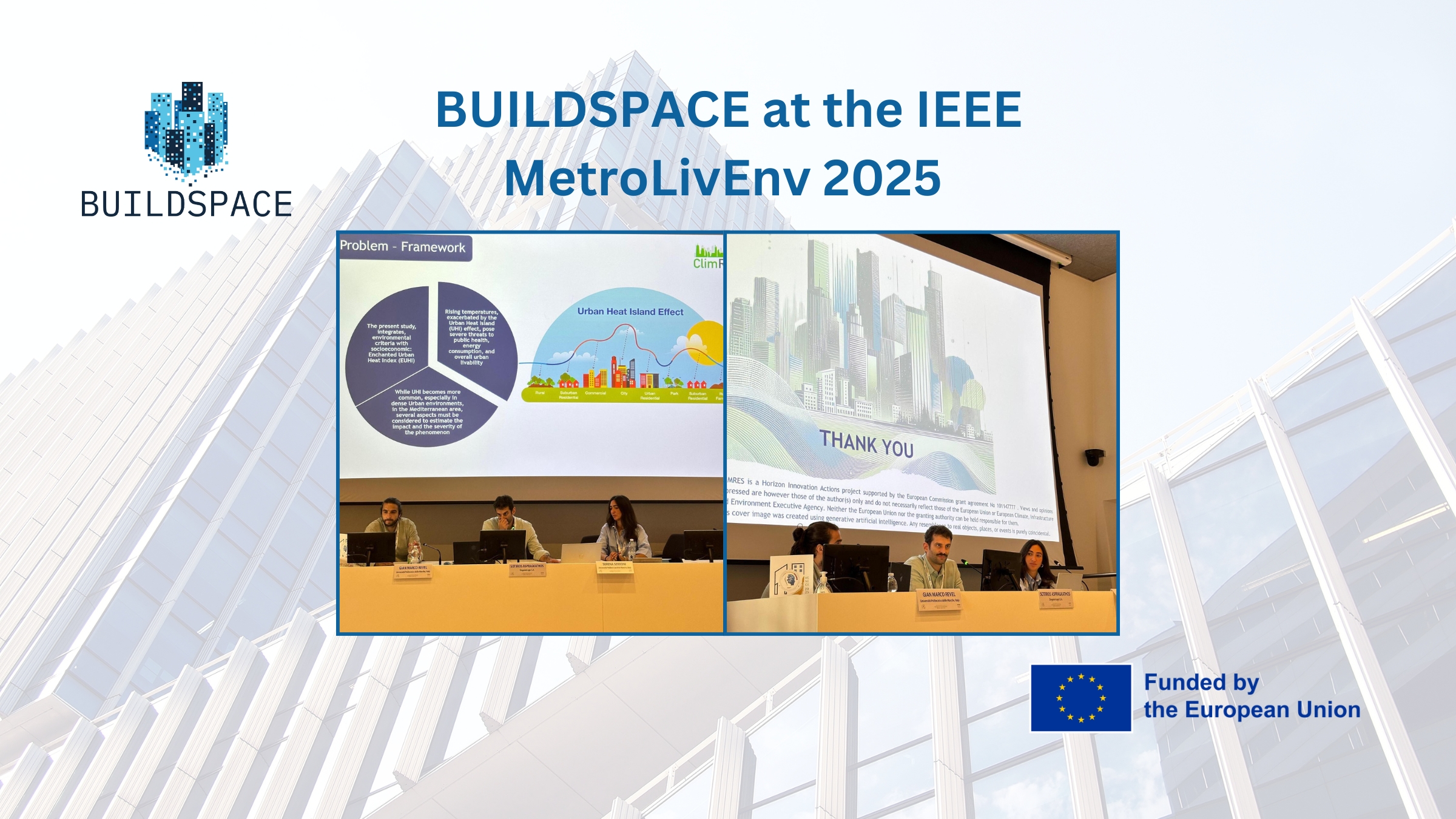
Last June, at the Metrology for Living Environment 2025 conference in Venice, a key conversation unfolded around how cities can assess and respond more effectively to climate risks. The MetroLivEnv 2025 is an international forum bringing together researchers, policymakers, urban planners, and technology experts to address the environmental challenges of metropolitan regions. The 2025 edition focused on innovative approaches to climate resilience, sustainable urban design, and the integration of environmental, social, and technological perspectives in city planning.
As part of this dialogue, the BUILDSPACE project was represented by the National Technical University of Athens (NTUA), who presented a pioneering study focused on urban heat vulnerability in Greece.
In the study “Integrating socio‑economic dimensions into climate‑resilience assessment of building stock: a case on marginalized groups in Athens” the NTUA led research introduced a GIS-based methodology to assess urban heat risk using an Enhanced Heat Resilience Index (EHRI) for Athens and the wider Attica region.
Unlike conventional risk models, this approach combines remote sensing data with socio-economic indicators drawn from national statistical sources. The result is a multi-layered, spatial understanding of how extreme heat disproportionately affects marginalised communities, a perspective that is often missing from broader climate resilience strategies.
Data-Driven and Equitable Urban Planning
The presentation emphasised the value of integrating spatial, environmental, and social data to inform equitable climate adaptation. This research, developed within the BUILDSPACE framework, demonstrates how data can support more inclusive planning, ensuring that no communities are left behind in the face of intensifying heatwaves and climate stress.
By identifying vulnerable zones with precision, city authorities can prioritise targeted interventions, such as greening initiatives, building retrofits, or improved access to cooling infrastructure. In doing so, they not only reduce health risks but also promote fairness and social equity in urban resilience planning.
BUILDSPACE’s presence at MetroLivEnv 2025 reflects its broader mission: to empower cities with smart tools that are not only technically advanced but also socially aware. The work presented by NTUA exemplifies this, offering a replicable model for other cities facing similar climate challenges.
📢 Are you interested in the impact of the BUILDSPACE Services and would you like to replicate this in your city?
Do not miss the opportunity to join our exclusive training and apply for the Open Call for Replication Potential by October 2025. Selected participants will gain exclusive access to high-level training on BUILDSPACE services, internal resources, and expert guidance.
Read the full call and apply here.
- Log in to post comments